Do You Really Need €500,000 to Run AI in Your Office?
Compare real Kimi K3 experiments, see why online hardware prices are not supplier quotes and learn what an SME should test before buying local AI.
Yes, half a million euros is enough to run the complete Kimi K3 model on hardware you control. One public build used 80 graphics cards and would cost roughly that amount at Spanish retail prices. Another ran the same model on 16 smaller systems whose listed equipment cost was closer to €80,000.
The gap between those figures is the useful part for an SME. An online build can show that a configuration works, but its shopping list is not the price of a working service for your company. That price still requires a defined task, a realistic test and a supplier quote.
Most SMEs do not need the complete Kimi K3 model. A local LLM for documents, internal search or reviewed drafts may cost €2,500-7,000 on one workstation. A shared installation for several employees may fall closer to €8,000-30,000.
Quick answer
A local LLM in an office can cost almost nothing on an existing computer or require hundreds of thousands of euros in new equipment. Public Kimi K3 experiments cover a very wide price range, but none is a ready-made quote for your company. For a typical SME, a realistic first hardware budget is €2,500-30,000. The correct figure depends on the task, number of users, required response time and whether local processing solves a real data or cost problem.
Does €500,000 really cover the full Kimi K3 model?
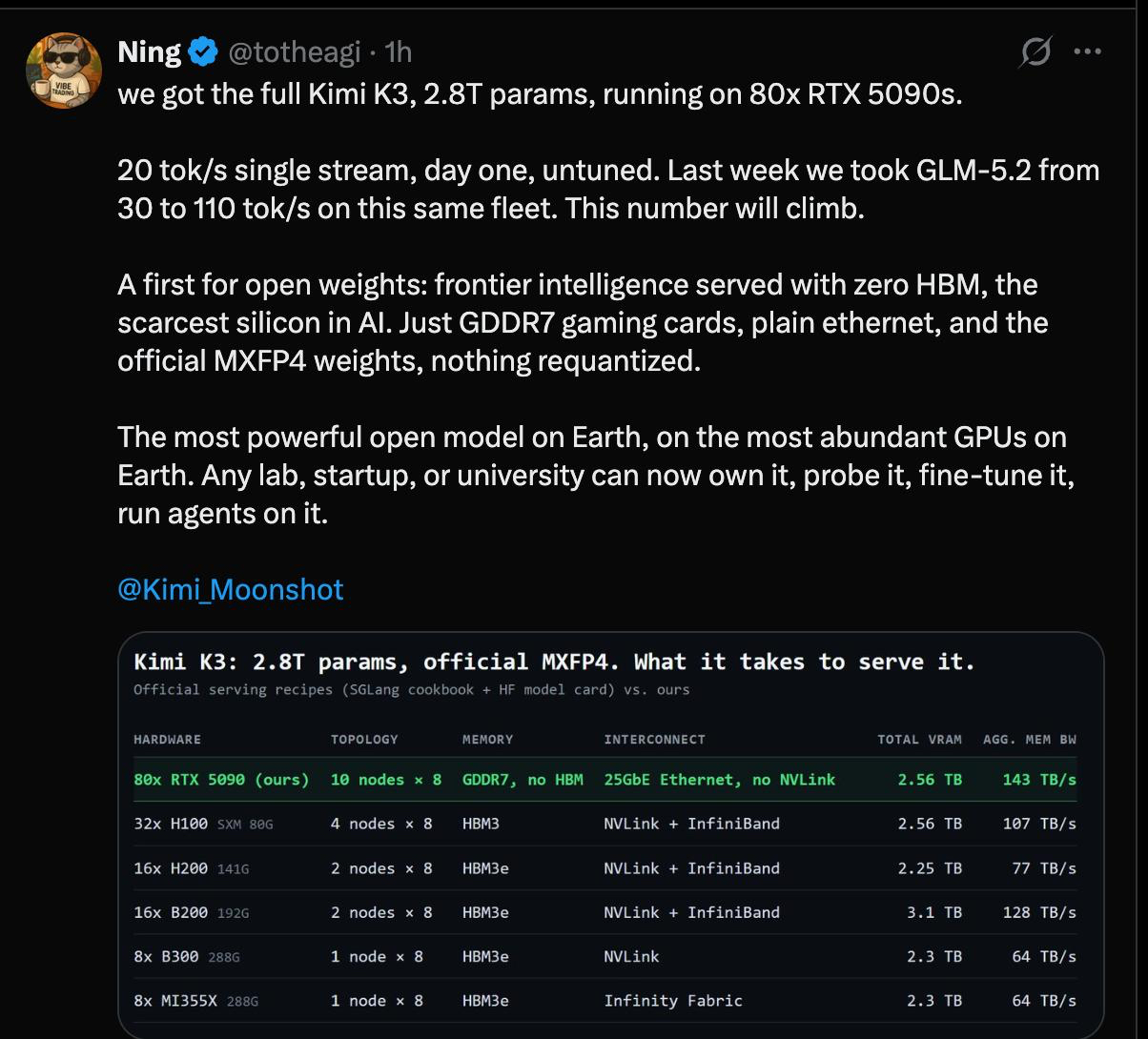
Yes. Kimi K3 is an exceptionally large current model, so the most ambitious public installations are far beyond a normal office computer. One of them divided the complete model across 80 graphics cards in ten connected machines.
At the Spanish retail price we checked, one RTX 5090 sold directly by PcComponentes cost €5,319 including VAT. Eighty cards at that price come to €425,520. This leaves about €74,500 within a €500,000 budget for the ten host machines, networking and the rest of the installation.
This makes half a million euros credible for that particular design. It remains a retail calculation rather than a supplier quote, and a company buying 80 cards would negotiate the price, warranty and VAT treatment.
Another public Kimi K3 build used 16 smaller GB10 systems. At NVIDIA’s European list price, those devices total about €77,000 before networking, integration and support. A finished company service would cost more, but this second build shows that €500,000 is only one possible design.
If a supplier uses either figure in a proposal, ask them to run your documents, state how many employees can use the system at once and include setup and support in the price. Without those answers, neither €77,000 nor €500,000 helps you make a purchasing decision.
The more useful question is whether an SME needs the complete Kimi K3 model. A company buying local AI for invoice processing or internal document search should not begin with the largest model available. It should begin with the smallest installation that passes the company’s real cases.
How much does a local LLM cost for an office?
The table below gives planning ranges for the hardware. It is intended for an initial budget conversation, not as a replacement for a supplier quote.
| Local AI setup | Indicative hardware budget | Example use |
|---|---|---|
| Existing compatible computer | €0-1,500 extra | One employee tests private drafting, classification or document search |
| Dedicated AI workstation | €2,500-7,000 | One or a few users work with documents and reviewed outputs |
| Shared local AI server | €8,000-30,000 | Several employees use one internal document or knowledge service |
| Powerful multi-GPU installation | €30,000-150,000+ | Higher volume, larger models or several demanding processes |
| Experimental full Kimi K3 clusters | Roughly €80,000-500,000+ | Research or AI products, not a normal SME starting point |
These ranges exclude the work around the model: connecting it to company systems, testing it with real documents, controlling access, training employees and supporting it after launch. A supplier should show those costs separately. A €5,000 machine is not a saving if employees cannot use its output, while a more expensive shared server may be justified when it removes a measured queue of recurring work.
Examples of local AI budgets for an SME
A consultancy that wants one employee to search a private archive and prepare drafts for review may start with a €3,000-7,000 workstation and test a model such as Qwen3.6-27B. The test should show whether the chosen model finds the right source material, produces acceptable Spanish and cites the document it used. Buying a larger model before this test adds cost without answering the business question.
A distributor that wants several employees to classify delivery notes, extract draft fields and check them against orders may need a shared server in the €8,000-30,000 range, perhaps testing Gemma 4 31B against its documents. The price depends less on the impressive name of the model than on document volume, simultaneous users and how many cases still require correction.
A company serving local AI to customers, running several intensive processes or developing its own AI product may reach €30,000-150,000 quickly. A proposal involving a much larger model such as GLM-5.2 belongs in this specialist category, not in a routine office pilot. At that point, monitoring, availability and support matter as much as the machine itself.
The published Kimi K3 configurations belong to a different category. They give a company control of a very large current model. That can make sense for a research group, an AI provider or an organisation with a specific reason to operate the full weights. It is difficult to justify as a general office assistant when smaller models can be tested for a fraction of the price.
Can Kimi K3 run on a MacBook instead?
Technically, yes. The MacBook experiment that prompted this article produced Kimi K3 output on an M1 Max machine with 64 GB of memory by loading model data from storage as it was needed.
Several software updates cut the waiting time sharply without changing the laptop or model. Longer and less predictable work remained slower, and the laptop was still impractical as a shared business service. The practical lesson is to ask a supplier to demonstrate your tasks instead of presenting a speed copied from someone else’s test.
Current smaller models change that calculation. They can run on a capable workstation or shared server at useful speeds. A supplier should compare them on the company’s task before proposing a much larger installation.
Is a local LLM cheaper than an API?
For a pilot or irregular use, an API usually avoids a large purchase. Moonshot currently prices the Kimi K3 API at $3 per million uncached input tokens and $15 per million output tokens before tax. Ten million input tokens and two million output tokens in a month would cost $60. Self-hosting can appear to repay its investment many times over when every generated token is valued at the public API price. A recent Kimi K3 estimate reached that conclusion by assuming almost continuous productive use, extremely high unverified throughput and that every output token replaced a paid API token. An SME should calculate savings from completed business tasks, not theoretical token production.
That example does not settle the decision. A company may choose local processing because documents must remain under its control, internet access is unreliable, usage is high and predictable, or dependence on one provider is unacceptable. Another company may prefer an API because it needs the model only occasionally and has no employee or supplier prepared to maintain local infrastructure.
A managed private service can sit between those options. The equipment remains outside the office, while the company receives dedicated capacity or stronger data controls. Our guide to local LLMs for SMEs explains how to compare local, cloud and hybrid costs without assuming one architecture always wins.
If the model will power an agent, hosting is only part of the project. Integrations, permissions, approval points and recovery still need to be designed, as covered in our guide to choosing an AI agent for an SME.
What should a local AI proposal include?
- The exact process the model will handle and the current volume of work.
- Results from representative company documents, including difficult cases.
- Expected response time and the number of employees who can use it at once.
- The complete three-year cost, including setup, integration, support and replacement.
- A comparison with a smaller local model, an API and a managed private option.
- A capped pilot that can be rejected before the production hardware is purchased.
The model name and equipment list should support those answers. They should not replace them. A proposal for “local AI across the company” is not ready to price until the supplier can show which work changes and how the company will judge the result.
So, how much should your company budget?
Budget around €2,500-7,000 to test a useful local LLM for one or a few people. Consider €8,000-30,000 when several employees need a shared internal service. Move beyond that only after the process, volume and required quality are measured.
Half a million euros can buy enough hardware to run the complete Kimi K3 model. A newer experiment ran it on equipment with a much lower list price. Neither figure tells an SME what to purchase. For most companies, the better purchase is the smallest setup that completes a defined process reliably and leaves enough budget for integration, review and support.
Our AI and process automation work starts with that process test so the infrastructure follows a proven requirement.
Sources and method
The article uses the original MacBook Kimi K3 experiment, its 5 August performance update, the 80-card deployment and the newer 16-node GB10 experiment as community evidence. Model size comes from Moonshot AI’s current model card. Equipment calculations use Spanish retail and NVIDIA European list prices checked on the dates stated. Planning ranges are indicative and are not supplier quotes or Taronja Nova customer results.