Does Your Business Need an AI Agent? A Guide for SMEs
Learn what an AI agent does, when an SME needs one, how agents differ from chatbots and automation, and what to ask before accepting a proposal.

A supplier offers your company an AI agent that can monitor email, prepare reports, update the CRM and follow up with customers. The demonstration takes a few minutes. The proposal may say much less about permissions, exceptions, staff review and who maintains the system after launch.
That gap matters because “AI agent” now describes products with very different levels of authority. One helps an employee research a topic. Another keeps running after everyone has logged off and can change records or send messages. Choosing between them starts with the work you want to change, not with a product list.
Quick answer
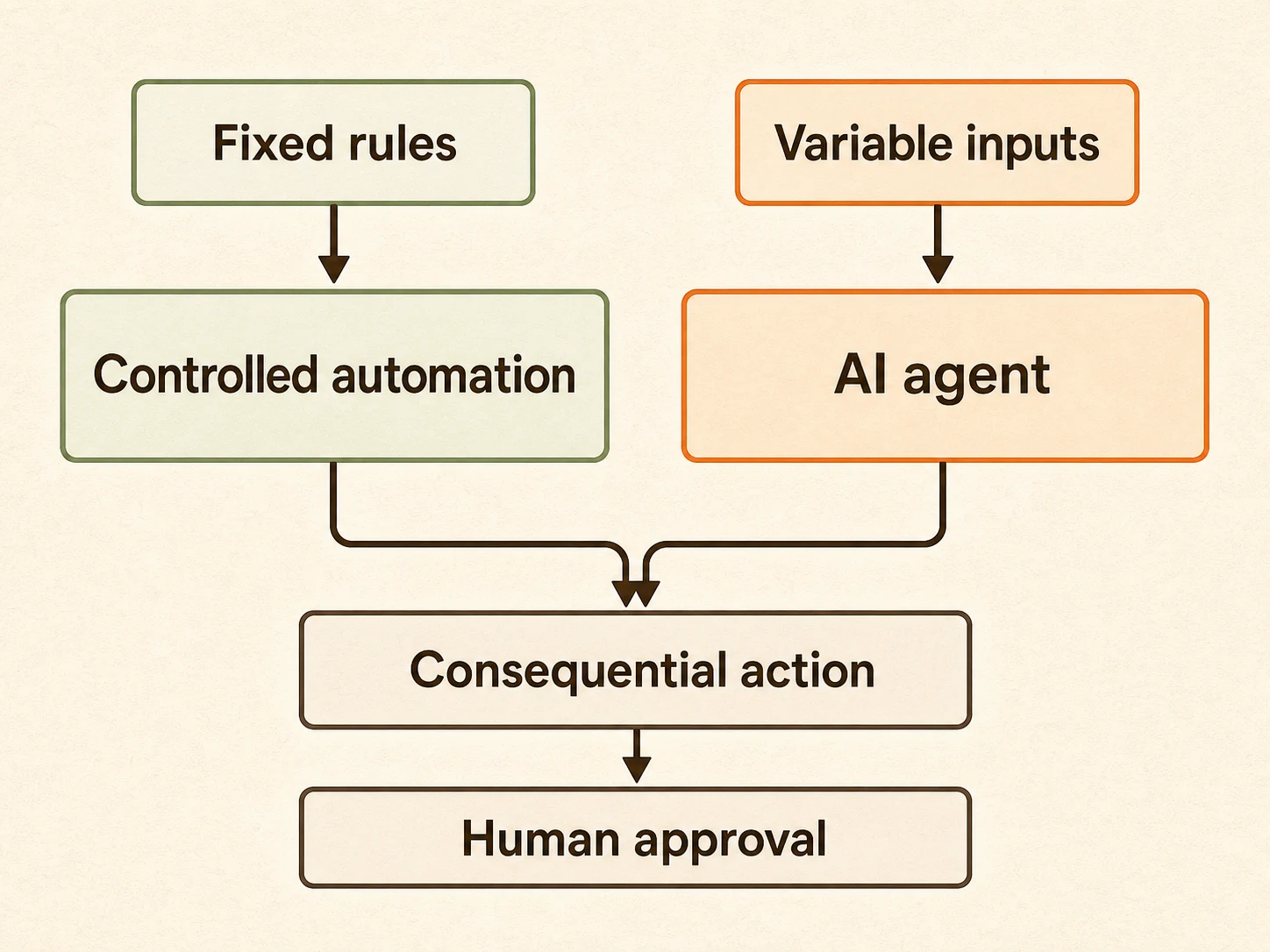
An SME needs an AI agent when a defined task has variable inputs, several steps and enough judgement that fixed rules become impractical. The result must be measurable, and someone must own the exceptions. If the work follows stable rules, controlled automation is usually easier to test, cheaper to support and less risky.
What is an AI agent?
An AI agent receives an objective, decides which steps to take and uses connected tools or information to complete the work. A current Google Cloud explanation of AI agents describes the same core pattern: an agent works towards a goal, reasons about the task and can interact with external systems.
The language model is only one part of the finished system. The agent also needs instructions, access to data, connections to applications, permissions and a way to record what happened. Some agents remember earlier work or wake up when an event occurs. Others complete one task while an employee waits.
The practical difference is delegated authority. A chatbot that drafts a reply leaves the action with the employee. An agent connected to the company inbox may read the request, check the customer record, prepare an answer, update the CRM and send the message. Each additional action changes the cost of an error and the controls the company needs.
What kinds of AI agents can a business buy?
Vendors use overlapping labels, so product names are less useful than the way the system will operate inside the company.
| Operating model | Suitable work | Main buying concern |
|---|---|---|
| Chat assistant | Employee-led research, writing, analysis and preparation. | Staff still check the result and carry out the next action. |
| Work agent | Multi-step reports, spreadsheet analysis, document preparation and project research. | The company must control which sources and applications it can use. |
| Process agent | Inbox triage, document routing, CRM updates and recurring operational reports. | Exceptions, approvals and recovery need to be designed before launch. |
| Persistent agent or “claw” | Ongoing monitoring or unusual cross-system work with a named technical owner. | Credentials, memory, unsupervised actions, updates and incident response. |
| Rule-based automation | Stable processes with known inputs, decisions and destinations. | It handles novel situations poorly, but is usually easier to trace and test. |
The same product can cover more than one row. ChatGPT Work and Claude Cowork can complete multi-step knowledge work. Workspace agents and products embedded in a CRM can run recurring processes. OpenClaw and Hermes can remain active, remember context and use a wider set of tools. A supplier should therefore explain the proposed operating model without relying on the word “agent”.
How can you tell whether the task needs an agent?
Start with one process that already exists. Record what starts it, which information employees use, what a correct result looks like and which cases require judgement. If the team cannot agree on the current process, an autonomous system will inherit that confusion.
Consider a weekly management report. When the data always comes from the same systems and the calculations are fixed, a dashboard or scheduled workflow may be enough. A work agent becomes useful when it must investigate missing figures, compare explanations across documents and prepare a draft commentary for a manager to review. The manager still owns the final interpretation.
Document processing follows a similar pattern. Standard invoices with known fields can move through extraction, validation and accounting software using a controlled workflow. An agentic step may help when formats vary, information is missing or the system needs to consult a contract before proposing an exception. Posting a payment or accepting a financial discrepancy should remain behind an approval appropriate to the risk.
Email and CRM work often sits between the two. An agent can classify an enquiry, find the relevant account, prepare a response and suggest the next CRM status. Allowing it to send the response or change the record automatically is a separate decision. The value comes from reducing a specific queue or review burden, not from giving the system every available permission.
A poor candidate has no stable owner, no baseline and no way to judge completion. “Help the sales team” is not a testable assignment. “Classify new distributor enquiries, prepare a draft reply using the approved price list and place uncertain cases in a review queue” can be tested against real cases.
When is ordinary automation the better choice?
Many SME processes are repetitive because systems do not exchange information cleanly. Data is copied from an email into a spreadsheet, checked against a rule and entered into a CRM or accounting application. If the decisions can be written as clear conditions, adding an open-ended agent introduces more possible behaviour without necessarily improving the result.
A useful design often combines both approaches. Deterministic steps move and validate data. AI handles a narrow point where language, document variation or classification makes fixed rules cumbersome. A person approves the cases with financial, legal or customer consequences. This structure keeps the process visible while using AI where it contributes something specific.
An agent becomes more defensible when the task cannot be reduced to a reasonable set of branches, yet the possible actions can still be limited. That distinction is more useful than a debate about whether agents are generally better than automation.
Which current option fits the way your company works?
For employee-led work that ends in a reviewable document, spreadsheet or analysis, a managed work agent is usually the easiest place to start. Current examples include ChatGPT Work, Claude Cowork and Codex. OpenAI reported more than five million weekly Codex users in June 2026 and said around 20% were non-developers. Anthropic’s July analysis of 1.2 million sampled Cowork sessions found business process and operations was the largest category. Both figures come from the vendors and do not prove that either product fits your process.
If the work is concentrated in one existing suite, an agent built into that suite may reduce integration effort because identity, data and access rules already exist there. The benefit depends on how much of the actual process stays inside the product. A workflow that crosses email, accounting, CRM, shared drives and a specialist industry application may still need separate integration work.
OpenClaw and Hermes suit a different requirement. They provide more freedom over tools, models, channels and ongoing behaviour, but the company takes on more operational responsibility. OpenClaw’s current security documentation assumes one trusted operator boundary per gateway rather than a hostile shared environment for unrelated users. A business considering a self-hosted agent needs a named technical owner, restricted credentials, monitoring and a recovery plan. The separate question of hosting and model cost is covered in our guide to local LLMs for SMEs.
How much autonomy should the agent receive?
Autonomy should increase only after the lower-risk version works. An agent can begin by preparing a draft. The next stage may allow it to recommend an action, then execute only after approval. Unattended execution belongs at the end of that progression, and some processes should never reach it.
The decision depends on reversibility and consequence. A badly formatted internal draft is easy to reject. An incorrect payment, deleted record, published statement or customer message may be expensive or impossible to recall. Access should be limited to the folders, records and actions required for the tested task rather than copied from a senior employee’s account.
Current end-to-end benchmarks also argue for caution. The April 2026 AutomationBench paper reported scores below 10% for the best tested systems on difficult, cross-application workflows. Its live leaderboard had reached 18.1% for the leading listed configuration when checked on 13 July. This is not a general failure rate for business agents: the benchmark deliberately tests demanding autonomous work without clarification or human help. It does show why a fluent demonstration cannot replace repeated testing on the company’s own cases.
What does an AI agent really cost?
Subscription or usage fees are the visible part of the cost. The company may also pay for process analysis, integration, data preparation, permissions, testing, employee review, monitoring, maintenance and recovery from failed runs. A low monthly licence can become expensive when staff spend hours correcting the output or when every change to the company’s software breaks the connection.
Compare the current process with the proposed one using the same unit: cost per correctly completed case. Include employee time before and after implementation, the share of cases that need correction, the cost of material errors and the supplier support required to keep the system running. For a process with seasonal peaks or many exceptions, test more than the easiest week.
The pilot needs a fixed set of representative cases, including difficult examples and known exceptions. Record the baseline first, run the same cases several times and agree what counts as acceptance. Our AI consulting and process automation work starts with this bounded process review so the technical choice follows the business requirement.

What should you ask when a supplier proposes an AI agent?
- Which existing process will change, and what volume, delay, cost or error are we trying to reduce?
- Why does this task require an agent rather than a chat assistant or a controlled workflow?
- Which data can the agent read, and which records, messages or files can it create, change, send or delete?
- Where does an employee approve customer-facing, financial, legal or irreversible actions?
- What happens when information is missing, tools fail or the agent is uncertain?
- Which representative cases were tested, how often did they finish correctly and how much human correction remained?
- Who maintains the instructions, integrations, permissions and tests when the agent or connected software changes?
- Can we inspect the execution history, revoke access, restore the previous process and export or delete our data when the contract ends?
The proposal should answer these questions in business language and connect each answer to the intended process. A generic demonstration, a model leaderboard or a promise of an “AI employee” does not establish completion rate, total cost or accountability.
Who remains responsible for the work?
The model provider, agent vendor, implementation partner and deploying company control different parts of the finished system. The supplier may operate the platform, while the company chooses the data, permissions, purpose and point at which the result affects an employee or customer.
Current European Commission AI Act guidance distinguishes between provider and deployer roles, with obligations depending on the system and its use. An office agent should not automatically be described as a high-risk system. The proposal still needs to identify who reviews its work, handles incidents, trains staff and decides when the agent must stop. Legal classification and data-protection requirements should be checked for the actual use case.
Human review is only a control when the reviewer has enough time, relevant knowledge and authority to reject the result. If the business case assumes that one employee will approve hundreds of complex cases in a few minutes, the approval step exists on paper rather than in the working process.
Make the decision on one process
Choose an agent when a defined task contains real variation, needs several tools and still allows a measurable result with bounded authority. Choose controlled automation when the path is stable and predictable. Keep the work with an employee when the consequences are high, the judgement cannot be tested or nobody can own the system after launch.
The first proposal should be small enough to reject. A useful pilot tells the company whether the agent completes the work, how much review remains and what it costs to keep operating. That evidence is worth more than choosing whichever product has the most convincing demonstration this month.
Sources and method
Product capabilities and availability were checked against current first-party documentation on 13 July 2026. Vendor usage figures are labelled as vendor evidence. Reliability claims use the linked 2026 research and its stated scope. Recent OpenClaw and Hermes community discussions helped identify practical objections, but comments were treated as individual experience rather than business performance evidence. No Taronja Nova customer result, saving or agent benchmark is claimed.